01Frost and Ice
A Sheet of Frost on the Freezer Back Wall
Check these before you call anyone
- 01
Empty one shelf and look straight at the rear panel. A light bloom of frost is normal; a smooth continuous sheet you cannot see the plastic through is not.
- 02
Trap a paper strip in the door at three heights and tug it. Wherever it pulls out easily, humid room air is getting in and the freezer is making its own ice.
- 03
Check nothing is jammed against that panel. A box pressed to the back wall holds moisture against it and stops the return air the coil depends on.
- 04
Listen with the door open and the light switch held in. A fan that whirs then rattles is catching the ice, which tells you how far the build-up has already gone.
- 05
Note when the freezer was last emptied and thawed. Ice that returns within a fortnight of a full thaw is a failed defrost circuit, not a habit you can manage around.
If none of that is it, stop there — the next step needs a meter. Sub-Zero Repair Experts Los Angeles, (310) 496-3358.
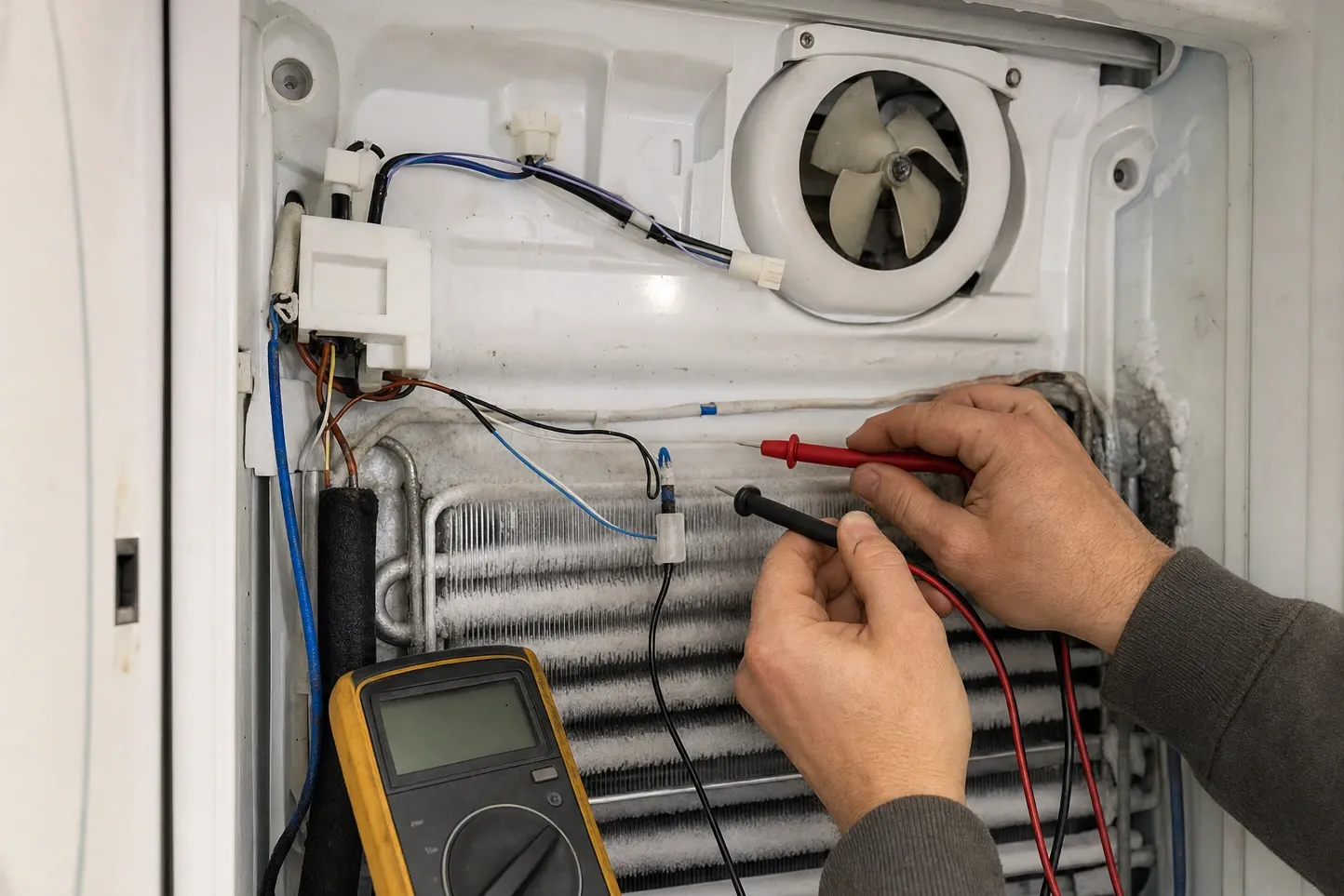
What is actually happening back there
Behind the rear panel is the evaporator: the coil of fins everything in the freezer gets its cold from. Air is pulled across it, leaves its moisture on the metal as frost, and returns to the compartment dry. A heater clamped to that coil is supposed to melt the frost off periodically and send it down a trough and a tube.
When that stops, the frost grows forward until it reaches the panel. What you see through the shelf gap is the front face of a block filling the space behind it. The fins pack, the air stops moving, and a freezer still running flat out slowly warms up.
Why it comes back after you clear it
Thawing removes the ice and none of the cause. Three parts can end the cycle: the heater, the sensor or thermostat that tells the control when to run it, and the control acting on that reading. All three sit behind the same panel, and all three are cheap next to the cabinet — but only one of them is yours, and finding out which needs a meter.
The tell is the interval. Ice back within a fortnight of a thaw means the circuit is dead rather than struggling; ice that takes months usually means a seal letting humid air in, which is a smaller job.
If it is not that
When the circuit behind the panel is the cause, the usual part and the usual figure are set out onthe defrost heater page.
If the ice is running rather than sitting — a wet stripe down the liner instead of a glaze — readmeltwater running down the inside wall instead.
Hillside kitchens see this one most, which is why it leadsthe Silver Lake page.
Follow-ups
Will turning the freezer colder clear the frost?
No, and it usually makes the compartment worse. The ice is there because the defrost cycle stopped melting it, not because the setting is too warm. Turning the dial down makes the compressor run longer against a blocked coil, and the freezer ends up warmer rather than colder.
Is the food still safe while the back wall is iced over?
For a while. A coil that is partly blocked still makes some cold, so the compartment drifts up slowly rather than failing outright. Once it climbs past the teens the food is on borrowed time, and that is the point to ring Sub-Zero Repair Experts Los Angeles on (310) 496-3358.
Can I chip the ice off myself?
Please do not. The coil, its sensor and the thin aluminium fins sit directly behind that panel, and a screwdriver through any of them turns a defrost repair into a sealed-system one. Unplugging the cabinet and letting it thaw is slower and does no damage.
Sub-Zero Repair Experts Los Angeles works on Sub-Zero freezers across the east side and the south valley. (310) 496-3358 — answered 24/7, on-site 8:00 am – 8:00 pm, seven days, $89 for the visit and the diagnosis.